The Most Important Shift in Live Events Since the LED Wall
Every decade or so, a technology arrives that fundamentally changes what is possible at a live brand event. In the 1990s it was digital projection. In the 2010s it was LED. In 2026, that technology is generative artificial intelligence — and its impact on live experiences is only beginning to be understood.
At NewMedia, we have been working with generative AI in live event environments since before it became a headline. We have built systems that generate real-time visual content in response to a speaker's words, audience energy, biometric data, and live music. We have deployed AI-driven projection mapping that evolves throughout an event, creating a different experience for every audience in every city.
What follows is what we have learned — and what every brand planning a major event in 2026 should know before their next brief.
What Generative AI Actually Means for Live Events
It is worth being precise about what generative AI means in an events context, because the term is often used loosely.
In a live event setting, generative AI refers to systems that create visual, audio, or interactive content in real time — not from pre-rendered files, but from algorithms that respond to inputs. Those inputs can be almost anything: the keywords a presenter uses, the emotion in their voice, the energy of a crowd, a product data feed, social media streams, or even the weather outside the venue.
The result is an experience that is alive. Not in a metaphorical sense — literally alive, changing moment by moment, impossible to fully predict, and therefore impossible to fully replicate. Every person who attends a generative AI event has a slightly different experience. That uniqueness is part of the value.
Five Ways Leading Brands Are Using Generative AI at Events Right Now
1. Real-Time Visual Backdrops That Respond to Speakers
The most immediate application is the replacement of static or pre-programmed stage backdrops with AI systems that generate visuals in response to live speech. When a CEO announces a new product, the environment behind them shifts to reflect that narrative in real time. When the energy in the room rises, the visual palette intensifies. The stage becomes a living extension of the story being told.
2. Personalised Audience Experiences at Scale
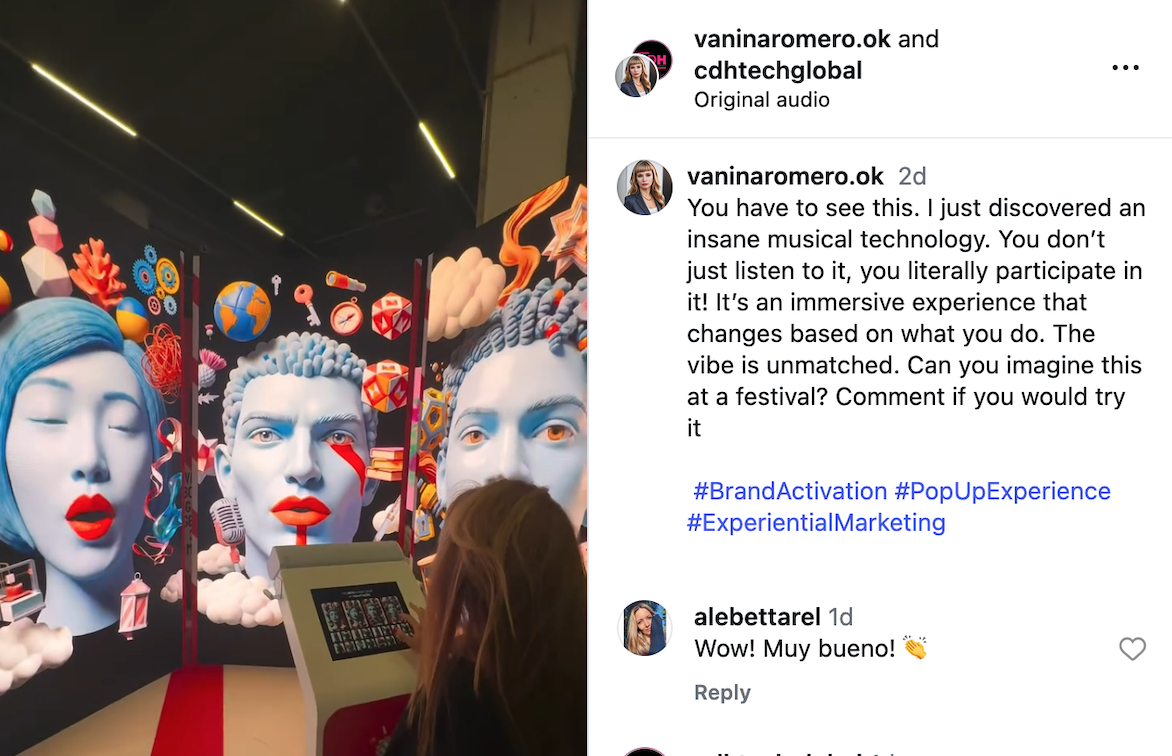
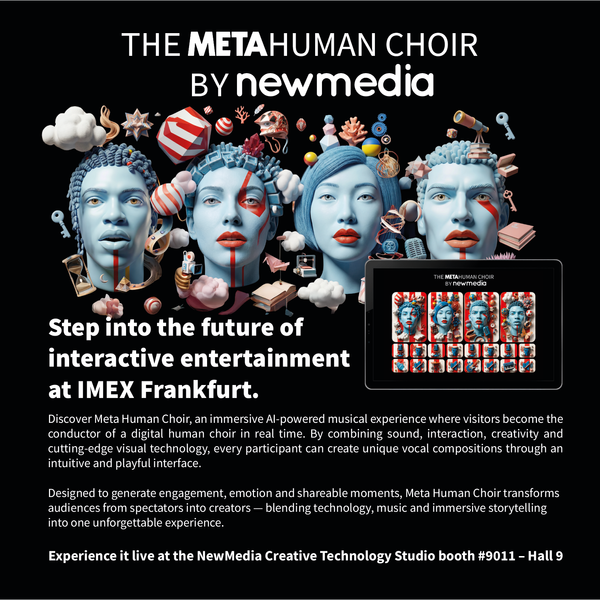
For brand activations and exhibitions, generative AI enables personalisation that was previously impossible at scale. Installations can generate unique visual outputs for each visitor based on their responses to questions, their movement through a space, or data drawn from their event registration. A financial institution can show each guest a version of the future that is specifically relevant to their business. A luxury brand can create a portrait of each customer using the brand's visual language.
3. Live Data Visualisation
For corporate events — particularly sales conferences, investor days, and product launches — generative AI can transform live data into visual narratives in real time. Rather than a presenter clicking through a slide deck of charts, the room around them responds to live numbers, turning data into experience. This is particularly powerful for global brands with complex stories to tell across multiple markets.
4. Immersive Environments That Evolve Throughout the Event
In dome environments and large-scale projection mapping installations, generative AI allows the visual environment to evolve over the course of an event — from arrival through dinner to the final keynote — without the production team manually triggering each change. The system learns the rhythm of the event and responds accordingly, ensuring the experience always feels fresh and alive.
5. AI-Enhanced Product Reveals
For product launches — particularly in automotive, consumer technology, and luxury sectors — generative AI allows the visual environment around a product to be generated in response to the product's own specifications. A new vehicle can be surrounded by a visual world generated from its design DNA. A new fragrance can be accompanied by a visual signature created from its ingredient profile. The result is a level of brand coherence that pre-produced content cannot achieve.
The Questions Brands Should Be Asking Their Production Partners
Generative AI in live events is not a plug-and-play solution. It requires expertise that spans creative direction, software development, real-time systems engineering, and live event production — disciplines that rarely exist under one roof.
Before briefing an event production partner on generative AI, we recommend brands ask these questions:
- Have you deployed generative AI in a live event environment? There is a significant gap between studios that experiment with AI and those that have delivered it under live event conditions — with real audiences, real deadlines, and zero tolerance for failure.
- Do you build your own systems, or do you use off-the-shelf tools? The most powerful generative AI experiences require custom-built systems. Off-the-shelf tools have real limitations in live, large-format environments.
- How do you manage creative control? Generative systems need guardrails. A brand's visual identity, values, and communication objectives must be built into the system architecture from the start.
- What happens when it goes wrong? Live systems have failure modes that pre-rendered content does not. A serious production partner will have contingency protocols for every scenario.
What Makes NewMedia Different in This Space
NewMedia is not a technology company that discovered events. We are an event production company that has spent years mastering technology — and that distinction matters enormously when the stakes are high.
Our generative AI capability is built on top of more than a decade of live event production experience. We understand the creative demands of a brand reveal, the technical constraints of a convention centre, the time pressure of a three-hour load-in, and the emotional weight of a moment that has to land perfectly for 2,000 people in a room.
We also build our own tools. Our real-time visual systems are developed in-house, which means we can customise them precisely to the requirements of each client and each event. There is no licence restriction, no vendor dependency, and no creative ceiling imposed by a third-party platform.
The Future Is Already Here
The brands that will lead in experiential marketing over the next five years are making decisions today about the partners they trust to help them navigate this shift. Generative AI is not a future technology for events — it is a present one. The question is not whether to explore it, but how quickly and with whom.
If you are planning a major event in 2026 and want to understand what is genuinely possible with generative AI — not in theory, but in practice, on your stage, with your brand — we are the team to talk to.
Contact NewMedia at welcome@newmedia.events or visit www.newmedia.events to see our work and start the conversation.