The Experience Economy Has a New Engine
Something significant has shifted in how leading brands think about live events and experiential marketing. The question is no longer whether to invest in immersive experiences — the industry data makes that case definitively. The question is how to deploy the technology that is now making those experiences genuinely transformative.
That technology is generative artificial intelligence.
In 2025, generative AI moved from the experimental fringe of brand activations into the mainstream of experiential strategy. For marketers, event producers, and brand directors in the United States and Canada, understanding this shift — and the data underpinning it — is no longer optional. It is a competitive requirement.
The Experiential Marketing Landscape in 2025: Scale and Momentum
Global experiential marketing spend reached $128.35 billion in 2025, and the direction of travel is clearly upward. Across the Fortune 1000, 74% of marketing leaders are planning to increase their budgets for live events and experiential activations. This is not a trend being driven by small brands experimenting with new formats — it is being led by the largest companies in the world, with the largest marketing budgets.
The underlying logic is sound. Traditional advertising channels face declining returns as attention fragments and ad-blocking proliferates. Live experiences, by contrast, create direct, undiluted contact between brand and audience — contact that generates memory, emotion, and advocacy in ways that media impressions cannot replicate. The data consistently confirms that experiential investment delivers disproportionate returns relative to other marketing channels.
Generative AI: The Market Context
To understand why generative AI matters to brand activations, it helps to understand the scale and velocity of the technology's adoption across the broader economy.
Global enterprise generative AI spending reached $37 billion in 2025, up from $11.5 billion in 2024 — a 3.2x year-over-year increase. Private investment in generative AI globally reached $33.9 billion in 2024, an 18.7% increase from the prior year. In the United States specifically, private AI investment reached $109.1 billion in 2024 — approximately 12 times the level of China's $9.3 billion.
Adoption within enterprises accelerated dramatically. By 2025, 78% of organizations reported using AI in at least one business function, up from 55% in 2023. Among Fortune 500 companies, 92% now leverage generative AI tools across their organizations.
The ROI case is well-established. According to IDC research sponsored by Microsoft, generative AI delivers an average return of $3.70 for every dollar invested. For top-performing AI leaders, that figure rises to an average ROI of $10.30. The Media and Telecommunications sector — which includes experiential and event production — reports an average 3.9x ROI on generative AI investments.
The Numbers at a Glance
- Global experiential marketing spend (2025): $128.35B
- Fortune 1000 marketers planning to increase experiential budgets: 74%
- Enterprise generative AI spending (2025): $37B (3.2x year-over-year growth)
- Average ROI on generative AI investment: $3.70 per $1 invested (IDC/Microsoft)
- Top AI leaders average ROI: $10.30 per $1 invested
- Enterprise AI adoption (2025): 78% of organizations using AI in at least one function
- Fortune 500 companies using generative AI: 92%
- US private AI investment (2024): $109.1B (12x China's $9.3B)
What Generative AI Actually Enables at Live Brand Events
The term “generative AI” is used broadly, so it is worth being precise about what it enables in a live event context and why that matters to brand marketers.
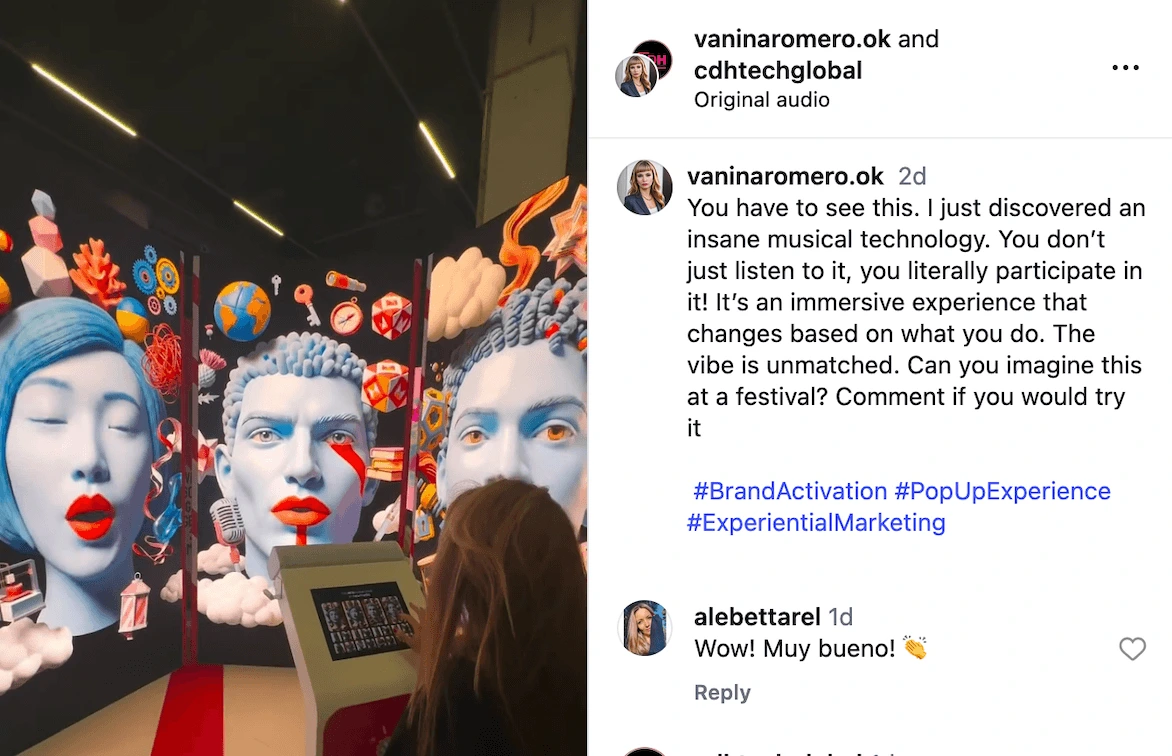
Generative AI in live events refers to systems that create visual, audio, or interactive content in real time — not from pre-rendered files, but from algorithms that respond dynamically to inputs. Those inputs can include a speaker's words and vocal tone, the energy level of a crowd, biometric data, live product data feeds, social media streams, or environmental conditions in the venue.
The result is an experience that is alive in a literal sense — changing moment by moment, impossible to fully predict, and therefore impossible to fully replicate. Every person who attends a generative AI activation has a slightly different experience. That uniqueness is both the mechanism and the value proposition.
Real-Time Visual Environments
The most immediate application is replacing static or pre-programmed stage backdrops with AI systems that generate visuals responsive to live content. When a CEO announces a new product, the environment behind them shifts to reflect that narrative in real time. When audience energy rises, the visual palette intensifies. The stage becomes a living extension of the story — and the emotional impact is measurably different from a pre-produced show.
Personalization at Scale
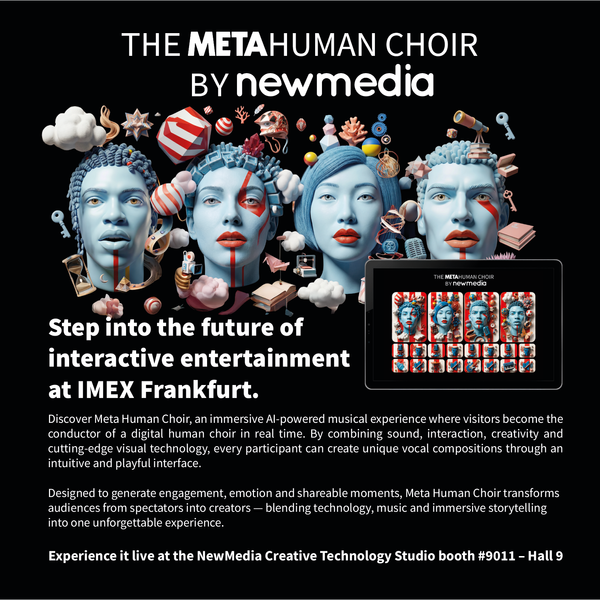
For brand activations and exhibition stands, generative AI enables personalization that was previously impossible at the scale live events demand. Installations can generate unique visual outputs for each visitor based on their responses, their movement through a space, or data drawn from event registration. A financial institution can show each guest a version of the brand's vision that is specifically relevant to their business profile. A luxury brand can generate a visual portrait of each customer using the brand's own design language.
This kind of one-to-one personalization in a physical, shared space creates a fundamentally different relationship between brand and audience — one that drives significantly higher engagement metrics and social sharing rates compared to generic activations.
Live Data Visualization
For corporate events — sales conferences, investor days, product launches — generative AI can transform live data into visual narratives in real time. Rather than a presenter navigating static charts, the room around them responds to live numbers. Global sales data becomes architectural. Sustainability metrics become light. This approach is particularly powerful for data-driven organizations seeking to communicate complex multi-market stories to high-stakes audiences.
Evolving Immersive Environments
In dome environments and large-scale projection installations, generative AI allows the visual environment to evolve across the arc of an entire event — from arrival through dinner to the final keynote — without requiring the production team to manually trigger each change. The system learns the rhythm of the event and responds accordingly, ensuring the experience remains fresh and alive throughout. This is architecturally significant: it shifts the production model from linear execution to responsive orchestration.
AI-Enhanced Product Reveals
For product launches in automotive, consumer technology, and luxury sectors, generative AI allows the visual environment around a product to be created in response to the product's own design specifications. A new vehicle can be surrounded by a world generated from its design DNA. A new fragrance can be accompanied by a visual signature created from its ingredient profile. The result is a level of brand coherence that pre-produced content cannot achieve — and an experience that communicates product identity rather than just product features.
The Business Metrics That Matter
Generative AI activations generate measurably superior performance across the metrics that brand marketers care most about.
Social sharing and user-generated content — Immersive, personalized, real-time experiences are fundamentally more shareable than static ones. When each attendee has a slightly different experience, the incentive to capture and share that experience increases substantially. This extends the brand's reach far beyond the physical event — earned media amplification that compounds the value of the activation investment.
Dwell time and engagement depth — Interactive generative AI installations consistently outperform static or pre-produced installations on dwell time metrics. Visitors who engage with a responsive environment spend more time, explore more deeply, and form stronger memory associations with the brand.
Brand differentiation — In a market where 74% of Fortune 1000 marketers are increasing experiential budgets, the bar for differentiation rises every cycle. A generative AI activation is, by definition, unique — it cannot be replicated by a competitor purchasing the same off-the-shelf technology. That uniqueness is a defensible competitive advantage.
Content production efficiency — Generative AI systems produce a continuous stream of branded visual content throughout the event. That content — captured by attendees and production teams — provides post-event content inventory that extends the campaign lifespan significantly beyond the event itself.
What the Best Brands Are Doing Differently
The gap between brands extracting full value from generative AI activations and those producing expensive novelties comes down to a small number of strategic decisions.
The brands winning in this space start with the emotional outcome they want to create — not the technology they want to deploy. The AI is a means to an end. The end is an audience that feels something specific, remembers the brand for a specific reason, and takes a specific action. Technology that serves that goal creates value. Technology that exists for its own sake produces impressive demos that are quickly forgotten.
They also invest in partners who understand both the creative and technical dimensions of live event production. Generative AI in a live event environment is not a software problem. It is a live production problem that requires software expertise. The failure modes of a live AI system are different from those of a pre-rendered show — and managing them requires experience that cannot be improvised under pressure in front of 2,000 people.
The North American Opportunity
The US and Canada represent the world's most mature and high-value market for premium brand experiences. The East Coast corridor — Boston, New York, New Jersey, Washington DC — is home to the highest concentration of Fortune 500 companies, financial institutions, pharmaceutical organizations, and technology firms globally. Las Vegas, Los Angeles, Chicago, and Miami anchor the West and South as the primary venues for major brand activations, product launches, and industry conferences.
These are markets where experiential production standards are exceptionally high, where brand reputations are built and damaged in single events, and where the investment in getting it right is justified by the audience that is in the room. For a production partner with genuine generative AI capability, the North American market represents the most demanding — and most rewarding — opportunity in the world.
NewMedia and Generative AI Activations in North America
NewMedia has been building and deploying generative AI systems in live event environments since before the technology became a headline. Our capabilities span real-time visual generation in response to live content, AI-driven projection mapping that evolves throughout an event, personalized interactive installations, and live data visualization at scale.
With our North American operations based in New Jersey — serving New York, Miami, Las Vegas, Los Angeles, Chicago, and the full US and Canadian markets — we bring the production standard of a global studio to the highest-stakes brand events in the world.
If you are planning a major activation and want to understand what is genuinely possible with generative AI — not in theory, but on your stage, with your brand, in your market — we are the team to talk to. Contact us at welcome@newmedia.events.