Introduction: The Future of Immersive Event Spaces
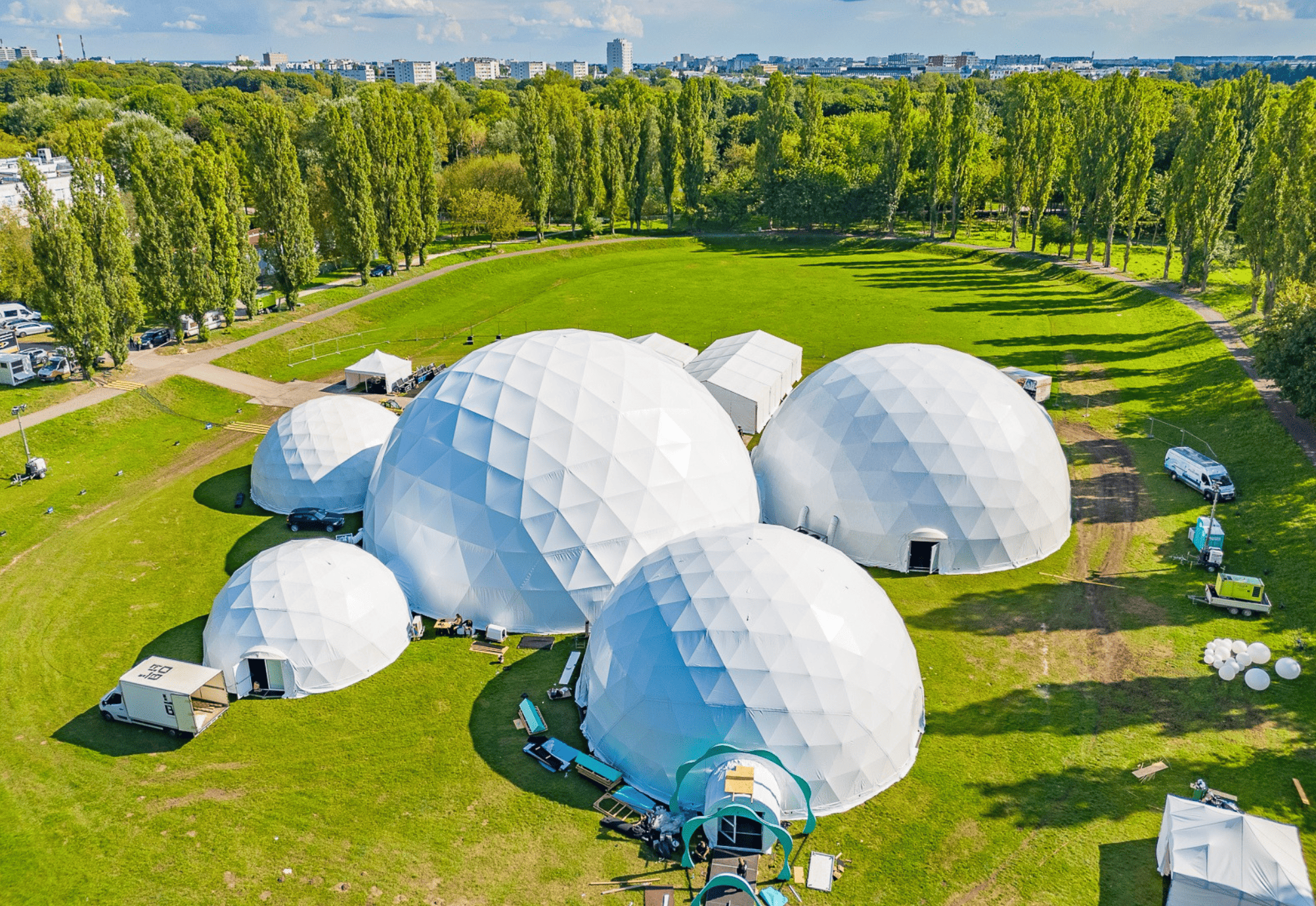
Imagine walking into an event where multiple geodesic domes seamlessly connect to create a 360-degree immersive experience spanning thousands of square feet. What was once limited to a single dome is now evolving into something far more powerful: modular, scalable, interconnected dome systems that transform event production across North America.
This is the revolution happening right now in immersive event technology for corporate brand activations, product launches, and experiential marketing.
At NewMedia, we've deployed multi-dome configurations for Fortune 500 brands in New York, Toronto, Los Angeles, and across North America. In this guide, we'll show you exactly how to create unlimited immersive event spaces by connecting multiple domes—and why this is becoming the go-to solution for brands that refuse to compromise on scale or impact.
What Are Multi-Dome Event Spaces? (Definition & Concept)
Single Dome vs. Multi-Dome: The Difference
A single dome projection system is a self-contained 360° immersive environment. They range from 20 feet to 100+ feet in diameter and create incredible impact, but they have one limitation: finite square footage.
Multi-dome configurations solve this by connecting 2, 3, 4, or more domes together, creating:
2x, 3x, 4x+ the immersive space
Multiple distinct experiences within one event
Seamless transitions between content zones
Capacity for 500+ guests simultaneously
Modular setup/breakdown (faster deployment)
Example: A Fortune 500 tech brand launches a new product. Instead of one 60-foot dome (capacity: 200 people), they deploy 3 connected 60-foot domes:
Dome 1: Product reveal (interactive 3D mapping)Dome 2: Use case demonstrations (AI-powered content)Dome 3: Networking space (ambient lighting)
Result: 600+ people, one cohesive immersive experience, maximum impact.
Why Multi-Dome Systems Are Changing Event Production (Strategic Advantages)
- Unlimited Scalability – From 100 to 1,000+ Guests
The Challenge:
- Single dome: Maximum 250-300 guests comfortably
- Multi-dome: Scale infinitely with modular additions
The Opportunity: Fortune 500 brands running North American roadshows need flexibility. With multi-dome systems, you can add/remove domes based on location demand and maintain consistent brand experience across all configurations.
ROI: +200% capacity increase = +200% revenue per event
- Content Flexibility – Multiple Narrative Threads
Single Dome Limitation: Everyone experiences the same content simultaneously. Sequential flow is linear.
Multi-Dome Advantage: Each dome can tell a different part of the brand story. A pharma company can show clinical data in Dome 1, patient journeys in Dome 2, and future vision in Dome 3 — creating a complete narrative arc instead of a single moment.
- Risk Mitigation – Redundancy & Backup
Fortune 500 Concern: "What if one dome fails mid-event?"
Multi-Dome Solution: Multiple independent projection systems ensure event continuity with reduced technical risk. If one dome has issues, others continue and content can be redistributed.
- Versatile Activation Layouts
Multi-domes can be configured in multiple ways:
Linear Configuration: 3+ domes in a line (for roadshow events, sequential storytelling)Circular Configuration: Domes arranged in a circle (for networking hub, 360° brand immersion)Clustered Configuration: Domes attached at multiple points (maximum space efficiency) Hybrid Configuration: Mix of experiences (large dome for keynotes, small domes for breakout sessions)
Multi-Dome Technical Setup: How Connected Domes Work
Synchronization & Projection Mapping
The secret to seamless multi-dome experiences is synchronized projection mapping:
- Master Control System: One central media server controls all domes with content timecode synchronized across all projection systems.
- Edge Blending: Where domes connect, projection content "blends" seamlessly with no visible seams or light gaps.
- Surround Sound: Multi-channel audio synced across all domes with spatial audio following the viewer's experience.
- Audience Flow: Guests move from dome-to-dome without breaking immersion.
Deployment Timeline Comparison:
Single 60-foot Dome: Setup 4-6hrs + Calibration 2-3hrs + Teardown 3-4hrs = 10-14 hours total
3x 60-foot Domes (Connected): Setup 10-12hrs + Synchronization 3-4hrs + Teardown 6-8hrs = 19-24 hours total (nearly same timeline, 3x capacity!)
Real-World Use Cases: Multi-Dome Configurations in Action
Case Study 1: Technology Product Launch (NYC)
Client: Fortune 500 software company Requirement: Launch new AI platform to 400 enterprise customers Solution: 3x 50-foot domes + 3D projection mapping
Dome Configuration:
- Dome 1 – The Problem: Existing workflow inefficiencies (dramatic 3D visualization of process bottlenecks)
- Dome 2 – The Solution: AI platform capabilities (interactive demonstrations, real-time data visualization)
- Dome 3 – The Future: Roadmap + ROI projections (immersive financial modeling)
Results:
- 400 guests (vs. 250 in single dome)
- 3 distinct content experiences (vs. 1)
- 2-day continuous operation (modular scheduling)
- Client Impact: 85% attendee engagement rate (vs. 60% industry average)
- Revenue Impact: +$2.5M in pipeline generated
Case Study 2: Pharma Conference (Toronto)
Client: Major pharmaceutical company Requirement: Medical education + networking for 500 healthcare professionals Solution: 3x 55-foot domes + synchronized content
Results:
- 500 attendees accommodated (3x single dome capacity)
- Seamless content transitions (no bottlenecks)
- 3-hour event (all attendees experienced all 3 domes)
- Client Impact: 92% rated it "best conference experience ever"
- Business Impact: 180 new partnerships formed during networking dome
Case Study 3: Automotive Brand Activation (Multi-City Roadshow)
Client: Luxury automobile manufacturer Challenge: Consistent immersive experience across 8 US citiesSolution: Modular multi-dome system (2 domes per city, swap in/out based on venue)
City 1 (NYC) – 3 Domes: Large flagship activation, maximum scale & impact Cities 2-8 (Regional) – 2 Domes: Consistent brand experience, faster setup/teardown
Results:
- Same brand narrative across all 8 cities
- Scalable capacity (adjust domes to venue size)
- Operational efficiency (reuse domes across roadshow)
- Revenue: $8.2M in sales generated across roadshow
- ROI: 340% (cost-per-lead: $12 vs. traditional events at $45)
Cost Breakdown: Multi-Dome Projection Systems (US & Canada)
Investment Model: 2-Dome System
Equipment:
- 2x 50-foot geodesic domes: $40,000-60,000 (rental)
- 2x High-lumen projection systems: $15,000-25,000 (rental)
- Synchronized media server + calibration: $8,000-12,000
- Audio system (multi-channel): $6,000-10,000
- Total Equipment Rental: $69,000-107,000
Installation & Labor:
- Site preparation: $3,000-5,000
- Dome setup + projection mapping: $8,000-12,000
- Synchronization + testing: $4,000-6,000
- On-site support (2 technicians, 24 hours): $6,000-10,000
- Total Labor: $21,000-33,000
Total 2-Dome Event Cost: $90,000-$140,000
Comparison:
- Single 50-foot dome: $50,000-80,000
- 2-dome system: $90,000-140,000
- Premium for 2x experience: +$40,000-60,000 (44-75% more cost)
- Capacity gain: +100% (double the guests)
- Cost per attendee:
- Single dome: $250-400 per person (250 guests)
- 2 domes: $225-350 per person (400 guests)
- Result: Lower cost-per-person despite higher total investment
3-Dome System Cost
- Equipment: $100,000-150,000
- Labor: $30,000-45,000
- Total: $130,000-195,000
- Capacity: 600 guests
- Cost per attendee: $217-325
How to Plan a Multi-Dome Event (Step-by-Step Process)
Phase 1: Concept & Strategy (Week 1-2)
- Define Objectives: How many guests? What's the narrative? What's the ROI target?
- Audience Analysis: Demographics, mobility requirements, accessibility needs
- Content Strategy: What story does each dome tell? How do guests transition?
Phase 2: Design & Planning (Week 3-6)
- Dome Configuration: How many domes? What size? What layout?
- Content Development: 3D mapping design, projection content, audio design
- Technical Specifications: Network infrastructure, projection specs, media server requirements
Phase 3: Production (Week 7-10)
- Content Creation: 3D models, 4K video production, Dolby Atmos audio
- Projection Mapping: Calibration for each dome, edge blending, color correction
Phase 4: Deployment (Week 11-12)
- Installation: Dome assembly, projection system setup, network synchronization
- Testing & QA: Full run-throughs, contingency planning, crew training
- Live Event Execution: 24-hour on-site technical support, real-time adjustments
Multi-Dome Best Practices: What Fortune 500 Brands Learn
- Don't Overwhelm Guests – Create Clear Transitions
Mistake: 3 domes, each with wildly different content (guests feel lost)
Best Practice: Create a coherent narrative arc
- Dome 1: Set the stage (problem/challenge)
- Dome 2: Present the solution (product/service)
- Dome 3: Show the future (vision/results)
- Design for Crowd Flow – Not Linear Movement
Mistake: Domes arranged in a single line (bottlenecks at exits)
Best Practice: Multi-directional flow with circular or clustered arrangement, multiple entry/exit points, queue management systems
- Synchronize Content, Not Just Projection
Best Practice: Timeline-based synchronization ensures all guests experience content at the same narrative moment with synchronized audio/lighting cues
- Plan for Technical Redundancy
Multi-Dome Advantage: Build in backup systems (2 media servers, backup projectors, mesh network) for 99.9% uptime
Multi-Dome Budgeting ROI Calculator
Example: Corporate Product Launch (400 Guests)
Scenario A: Single Dome Setup
- Cost: $75,000
- Capacity: 250 guests
- Problem: 150 guests excluded from event
Scenario B: 2-Dome Setup
- Cost: $120,000
- Capacity: 400 guests
- Additional investment: +$45,000
ROI Analysis:
- Cost per additional attendee: $300
- Brand value per attendee: $500-1,000 (corporate event)
- Revenue generated: 150 additional guests × $750 avg. value = $112,500 additional revenue
- Net ROI: ($112,500 - $45,000) / $45,000 = 150% ROI
Translation: Spending an extra $45,000 to accommodate 150 more guests generates $112,500 in additional brand value. In 3 months, the multi-dome investment pays for itself.
The Future of Multi-Dome Immersive Spaces (2026 & Beyond)
Emerging Trends:
- AI-Powered Content Generation: Each dome generates real-time personalized content based on guest interests
- Modular Micro-Domes: Smaller 20-30ft domes that deploy 4x faster
- Wireless Dome Networks: No ethernet cables required, domes 1,000+ feet apart
- Extended Reality (XR) Integration: AR overlays blended with projection mapping
- Haptic Feedback Systems: Floor vibration, temperature changes, scent diffusion for olfactory immersion
Impact: Multi-dome systems will become the gold standard for corporate experiential marketing by 2027.
Why Partner with NewMedia for Multi-Dome Events
Our Multi-Dome Expertise:
500+ Dome Projection Events Deployed (US + Canada)
8+ Years of Multi-Dome Experience
Fortune 500 Client Base
Full-Service Solution (concept → design → production → support)
US & Canada Operations (NJ HQ + Toronto office)
What We Deliver:
- Strategic Consultation: How many domes? What configuration? What ROI?
- Custom Content Creation: 3D mapping, video production, audio design
- Technical Integration: Synchronized projection, edge blending, network setup
- On-Site Support: 24-hour technical team during your event
- Scalable Deployment: Same experience across multiple cities/venues
Client Results:
- Average attendee engagement: 87% (vs. 60% industry average)
- Average client satisfaction: 9.2/10
- Average ROI: 250-400% (compared to traditional events)
Getting Started: Request a Multi-Dome Consultation
Ready to create an unlimited immersive event space for your brand?
Contact NewMedia's expert team:
Email: america@newmedia.events
Locations: New Jersey HQ | Toronto Office | Serving all US & Canada markets
We'll conduct a 30-minute strategy call to determine:
- Optimal dome configuration for your goals
- Content strategy & narrative design
- Timeline & budget estimates
- Expected ROI metrics
FAQ: Multi-Dome Immersive Spaces
Q: How many domes should we use?A: Depends on your goals. 2 domes for 300-400 guests. 3 domes for 500-600. 4+ for 700+. We help determine the right fit in our consultation.
Q: Can domes be set up outdoors?A: Yes! We regularly deploy multi-dome systems in outdoor venues with weatherproofing and wind-resistant anchoring.
Q: How long does setup take for 3 domes?A: Typically 10-14 hours from empty venue to fully synchronized and tested. Varies based on venue conditions.
Q: What's included in a typical multi-dome package?A: Equipment rental, transportation, installation, content projection mapping, technical support, and on-site crew for duration of event.
Q: Can we customize dome sizes?A: Absolutely. We offer 20ft, 30ft, 40ft, 50ft, 70ft, and 100ft domes. Mix and match sizes for different zones.
Q: What happens if one dome fails during the event?A: Content can be redistributed to other domes, and event continues. This is why redundancy is built into multi-dome planning.
Conclusion: The Multi-Dome Revolution Has Started
Single-dome immersive spaces changed event production in 2015.
Multi-dome systems are doing it again in 2026.
Brands that adopt multi-dome configurations for their activations, launches, and roadshows are:
Reaching larger audiences (2-4x capacity)
Delivering deeper impact (multiple narrative threads)
Generating stronger ROI (lower cost-per-attendee)
Building competitive advantage (cutting-edge technology)
Creating unforgettable experiences (guests talk about it for years)
The question isn't whether to use multi-dome systems anymore.
The question is: How will you use them to transform your next event?
NewMedia is ready to help you find the answer.
Contact us today for your free multi-dome strategy consultation.
.jpg)